Prostate Health · Healthy Aging
What Most Men Over 50 Wish They'd Understood Sooner About Their Prostate

Getting up at night, a weaker stream, the sense you're never quite empty — it's one of the most common changes of a man's 50s, and one of the least talked about. Here's what's actually happening, what the research says, and where nutrition honestly fits in.
It usually starts so quietly you can't name the day it began. One night you're up at 3 a.m. for the bathroom. Then it's a couple of nights a week. Then most nights. You catch yourself locating the restroom the moment you walk into a restaurant. The stream isn't what it was — it takes a beat to start, slows in the middle, and even when you're finished there's that nagging sense you didn't quite empty. So you explain it away. The late coffee. The extra glass of water. Just getting older.
If any of that lands a little too close to home, here's the first thing worth saying plainly: you are in enormous company, and there's usually nothing shameful or frightening about it. You've just run into one of the most common — and least discussed — parts of being a man past 50.
Men will compare notes on their knees, their backs, their cholesterol, their golf swing. The bathroom thing, almost never. So it can feel like it's just you, quietly rearranging your evenings around how far you are from a toilet. It isn't just you. Not remotely.
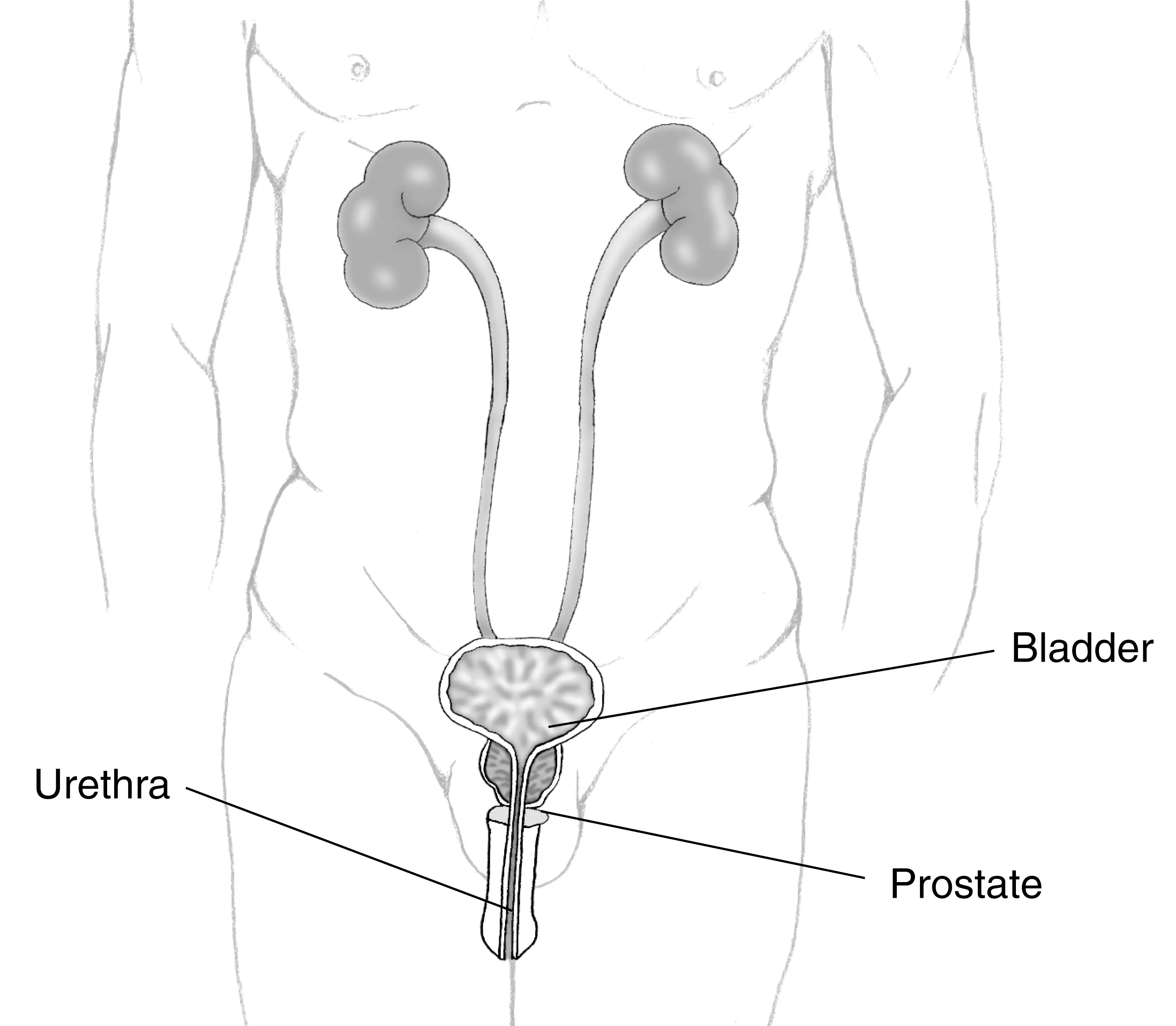
So what's actually going on down there?
The prostate is a small gland, about the size of a walnut, that sits just below your bladder. And it has one design quirk that explains almost everything you're feeling: the tube that carries urine out of your body runs directly through the middle of it.
As men age, the prostate tends to grow. This is benign prostatic hyperplasia (BPH), and it's the most common prostate condition in men over 50 — it rarely causes symptoms before age 40.1 It's gradual, benign in most cases, and remarkably common: prevalence climbs steadily with age, by some measures affecting roughly half of men in their 60s and the majority of men over 70.2 It isn't a moral failing, a sign of a bad lifestyle, or usually anything dramatic. It's biology.
The mechanism is simple. As the gland enlarges, it squeezes the urethra that runs through it.1 Picture stepping lightly on a garden hose: the water still comes, but the flow weakens, starts and stops, and never quite clears. That's the mechanism behind the weaker stream, the hesitation, the "did I really finish?" feeling, and the 3 a.m. wake-ups.
Once you understand it's the plumbing and not some personal failing, the whole thing stops feeling like weakness and starts feeling like biology — which is exactly what it is.
There's also a newer thread researchers have been pulling on: the role of healthy blood flow to and around the prostate, and how circulation relates to normal function in the tissue. This work is still early and far from settled, so it deserves caution rather than hype. But it's part of why the conversation about prostate health has widened beyond the gland's size alone, toward the everyday factors — circulation, nutrition, lifestyle — that support how the whole system works.
What most men try first — and why it only goes so far
When the symptoms creep in, the instinct is to manage around them. The usual playbook looks like this:
- Cutting off all fluids after dinner, hoping for fewer night-time trips
- "Going just in case" before every car ride, meeting, or movie
- Quietly mapping the bathrooms everywhere you go
- Assuming it's simply the price of getting older and saying nothing
None of these are wrong, exactly. But they're coping strategies — ways to live around the issue rather than understand and support what's happening. And because so few men ever raise it, most never get past the workaround stage to ask the more useful question: what actually supports a healthy prostate as you age?
Where nutrition genuinely fits
Here's the honest, unglamorous foundation, and nothing changes it: the basics do the heavy lifting. Staying active. Keeping your weight in a healthy range. Timing your fluids sensibly. And — the one men skip most — keeping up with regular check-ups so a professional is actually tracking your prostate over time.
On top of that foundation, nutrition is the layer a lot of men have started paying closer attention to. The logic is simple: your body relies on specific vitamins, minerals, and plant compounds for normal prostate, urinary, and hormone function. The idea behind a well-formulated prostate supplement isn't to fix or cure anything — it's to help make sure your body isn't short on the everyday building blocks it uses to keep that system working normally.
One supplement in this category is ProstaVive, a once-a-day powder you mix into water, formulated to support prostate health, healthy urinary flow, and normal circulation. Transparency matters here, so this is the full ingredient list — with an honest note on how strong the evidence actually is for each:
What to realistically expect
If you decide to try a prostate supplement, go in with the right frame of mind. This isn't a switch you flip overnight. Nutrients support your body's normal processes gradually, which means consistency over weeks matters far more than any single dose — and it works best layered on top of the basics, not instead of them, and not instead of your doctor. Some men feel it's a worthwhile part of their routine; some don't. That honest variability is just how supplements work, and any page promising guaranteed, dramatic, fast results is telling you something that isn't true.
What's reasonable is this: understanding what's actually happening with your prostate, supporting it sensibly through lifestyle and nutrition, and keeping your doctor in the loop. That's a genuinely good position to be in — and a long way from quietly mapping bathrooms and hoping it sorts itself out.
If you want the full picture
If this way of thinking about it resonates — supporting your prostate health through nutrition while staying on top of the medical side — the makers of ProstaVive walk through the complete formula, the dosages, the research they reference, the pricing, and their money-back guarantee in a full presentation on their official site. It's worth watching the details in full and deciding for yourself whether it fits into your routine.
References
- National Institute of Diabetes and Digestive and Kidney Diseases (NIDDK), NIH. Enlarged Prostate (Benign Prostatic Hyperplasia).niddk.nih.gov
- Ng M, Baradhi KM. Benign Prostatic Hyperplasia. StatPearls, NCBI Bookshelf. ncbi.nlm.nih.gov/books/NBK558920
- Safarinejad MR. Urtica dioica for treatment of benign prostatic hyperplasia: a prospective, randomized, double-blind, placebo-controlled, crossover study. J Herb Pharmacother. 2005. pubmed.ncbi.nlm.nih.gov/16635963
- National Institutes of Health, LiverTox. Stinging Nettle (Urtica dioica). NCBI Bookshelf. ncbi.nlm.nih.gov/books/NBK589898